Proactive Renewal Engine
The Problem
GRR was 81%. Leadership assumed it was a product problem. Before touching the renewal process, the churned account analysis told a different story: of the last 20 churned accounts, only 3 cited product gaps. The rest were relationship failures — champion left and nobody noticed, value story was never told, conversation started when the decision was already made.
The product was fine. Renewal conversations were starting inside 30 days of expiry. At that point there is no leverage, no time to resolve anything, and no way to change the outcome.
The Engine
Renewal calendar infrastructure. Salesforce contract objects cleaned up: renewal dates, ARR, product tier, auto-renewal clause status, and discount terms all standardised across every account. Any account with a discount expiring at renewal was flagged automatically — the value conversation needed to happen before the pricing conversation, not at the same time.
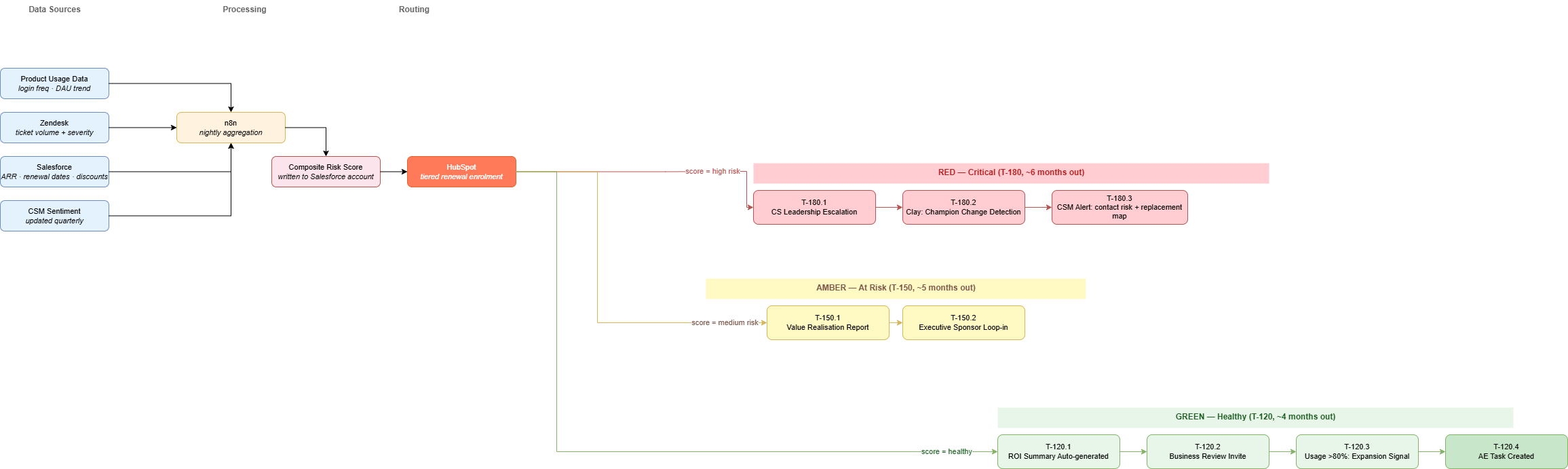
Risk signal aggregation. n8n ran a nightly job pulling signals from four sources: product usage data (login frequency, feature adoption, DAU trend from data warehouse), support ticket volume and severity (Zendesk), commercial signals (payment history, ARR trend from Salesforce), and CSM sentiment score (manually updated quarterly). Composite risk score calculated across all four dimensions and written back to the Salesforce account object — recalculated nightly, not quarterly.
Tiered renewal playbooks. HubSpot enrolled accounts in renewal tracks based on risk tier and days to renewal. Green accounts at T-120: light-touch business review, ROI summary auto-generated from usage data. Amber at T-150: CSM-led health check, executive sponsor looped in, value realisation report shared before any commercial conversation. Red at T-180: immediate escalation regardless of timeline, CS leadership notified, executive relationship activated. If a discount was expiring, value justification was prepared at this point, not at T-30.
Expansion signal detection. Green accounts at T-120 with usage above 80% of contracted capacity were flagged as expansion candidates simultaneously with the renewal review. CS packaged the opportunity for the paired AE — health summary, usage data, champion context, whitespace identified. Renewal and expansion became the same conversation for the right accounts.
Champion change detection via Clay. For red-tier accounts, Clay enriched the buying committee — identifying if key champions had changed roles, been promoted, or left the company. A champion departure is the strongest leading indicator of churn that does not show up in usage data. CSMs alerted before the renewal call, not during it.
Outcome
- GRR improved from 81% to 91% within two renewal cycles
- Average renewal engagement start moved from 38 days pre-expiry to 147 days
- Champion departure detected in 6 at-risk accounts before renewal conversation — 4 retained through relationship rebuild with new stakeholder
- £340K expansion pipeline generated from renewal-stage accounts in the first cycle
Tools
- Salesforce
- n8n
- HubSpot
- Zendesk
- Clay