CS Signal Distribution
The Problem
A CS team of 18 sat on some of the richest customer intelligence in the business — what customers were struggling with, what they wanted built, which competitors were appearing in renewal conversations. None of it was leaving the team.
In one case, a specific competitor had been mentioned in 60% of renewal conversations for three months before Sales found out — because no CS rep had a channel to surface it. Product were building features based on sales requests, not customer feedback. Marketing messaging was based on assumptions. The intelligence existed. It had no distribution.
The Engine
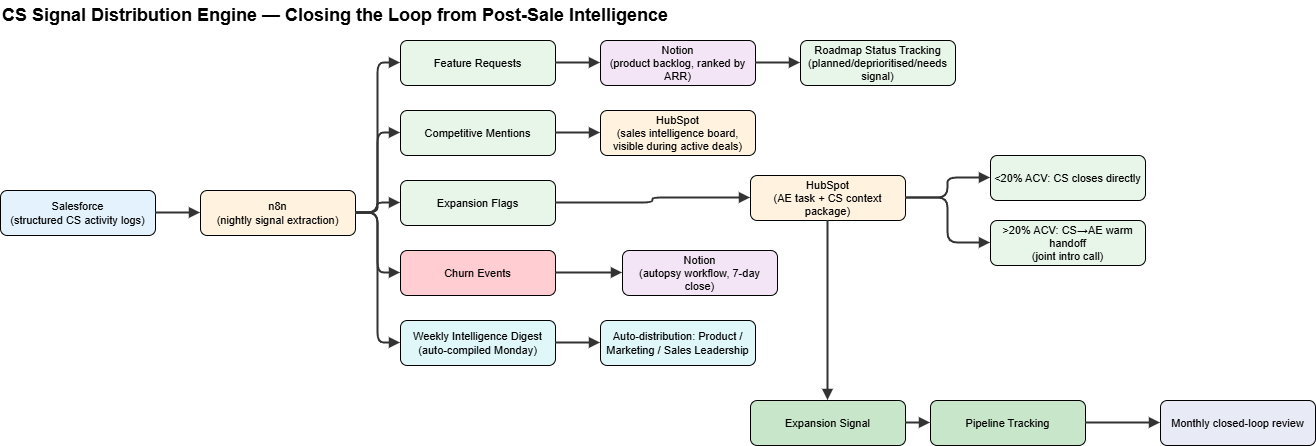
Signal capture standardisation. Salesforce activity logging for CS made structured: every QBR, health check, and renewal call required a post-call summary against a fixed template — top pain point raised, expansion interest flagged, competitive mention logged with context, feature request captured with business impact noted. The problem was not free text. It was unstructured free text.
Automated signal extraction and routing. n8n processed new CS activity logs nightly. Feature requests tagged and routed to a Product Requests database in Notion — with customer ARR and use case attached, so Product could prioritise by revenue impact, not just frequency. Competitive mentions routed to a Sales Intelligence board in HubSpot visible to AEs during active deals. Expansion flags created tasks for the paired AE with account health, ARR, and CSM context. Churn events triggered an autopsy workflow: CS Manager notified, structured template created in Notion, root cause required within 7 days.
Expansion ownership model. CS closed expansions below 20% of current ACV directly. Above that threshold, CS packaged the context — health score, champion details, what changed, why now — and introduced the AE on a joint call. CS stayed involved through close. Credit split tracked: CS sourced, Sales closed.
Weekly CS intelligence digest. n8n compiled a weekly digest every Monday: top 5 pain points raised that week, feature requests ranked by ARR of requesting accounts, competitive mentions by competitor with context, expansion signals created. Auto-sent to Product, Marketing, and Sales leadership. One page. No manual effort from CS.
Closed-loop feedback. HubSpot tracked which CS-sourced expansion signals converted to pipeline and closed. Notion tracked feature requests against roadmap decisions — planned, deprioritised, or needs more signal. Monthly review in revenue cadence: what CS surfaced, what Sales used, what Product shipped. CS became a function leadership wanted to hear from, not just report to.
Outcome
- £800K in net-new expansion pipeline from CS-sourced signals in first 6 months
- Product received 3x more structured customer feedback per sprint, ranked by ARR impact — two previously deprioritised features moved up the roadmap within 60 days
- Competitive intelligence from CS directly influenced two Sales win strategies
- Marketing rewrote two pieces of copy based on CS pain point language — both outperformed previous versions in A/B testing
Tools
- Salesforce
- n8n
- Notion
- HubSpot