Meeting Intelligence Engine
The Problem
Running multiple concurrent engagements, the richest GTM intelligence — what problems keep coming up, what questions clients always ask, what outcomes are credible and defensible — was trapped in meeting notes. Each engagement was treated as isolated.
The same question came up from a Series B fintech and a Series C logistics company in the same week, and there was no way to see that. Use cases were being reconstructed from memory at proposal time, months after the work was done. Memory compresses out the specific detail that makes a portfolio piece credible.
The Engine
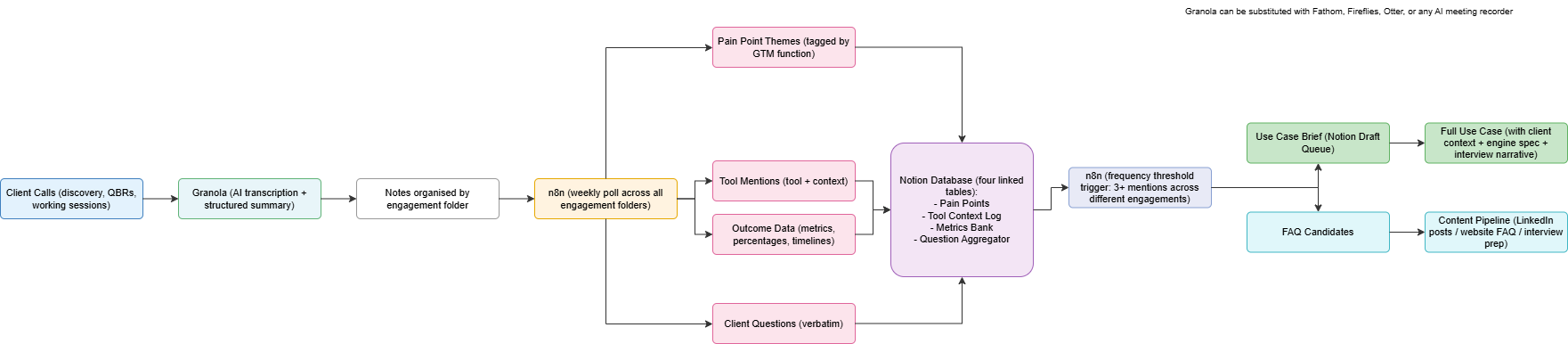
Meeting capture. All client calls recorded and transcribed via AI meeting recorder (Granola, Fathom, Fireflies, or equivalent — the automation layer is tool-agnostic). Post-meeting AI summary structured with: key problems raised, tools mentioned with context, outcomes discussed including any numbers cited, and explicit questions the client asked. Notes stored per engagement in folder structure — one folder per active client.
Pattern extraction via n8n. n8n polls all active engagement folders weekly. For each new meeting summary, extracts and classifies: pain point themes tagged by GTM function, tool mentions with context, quantified outcome data, verbatim client questions, and objections or scepticism raised. Structured fields, not free text — so the output is machine-readable.
Aggregation in Notion. Extracted signals written to a Notion database across four tables: pain points (theme, frequency, source engagement, verbatim quote), tool mentions (tool, context, engagement), outcome data (metric, context, credibility flag), and client questions (question text, topic, frequency). n8n flags any pain point theme appearing in 3 or more meetings across different engagements — these become use case candidates.
Use case draft trigger. When a theme hits the frequency threshold, n8n creates a structured brief in Notion: problem statement compiled from verbatim quotes, tools mentioned in context across engagements, outcome data captured with source. The brief is the raw material — reviewed and built into a full use case with client context, engine spec, and interview narrative.
Common questions feed. Client questions extracted from meeting summaries are aggregated separately. Any question appearing 3 or more times across different industries becomes a content candidate: website FAQ, LinkedIn post, or interview prep. Questions that come up repeatedly are the questions an interviewer will ask — they reflect what the market does not understand yet.
Outcome
- 8 use case briefs auto-generated in first 3 months — 5 built into full portfolio use cases
- 14 recurring client questions identified across engagements; 6 became LinkedIn content, 3 became website FAQ copy
- Cross-engagement patterns visible in real time — a competitor appearing in CS renewal calls at one client was simultaneously surfaced in Sales objections at another, caught in the same weekly digest
Tools
- Granola / Fathom / Fireflies
- n8n
- Notion